

Somewhere in a rather grand building in Washington sits a man whose name still means very little to most of the people whose mortgages he now controls, and over the past fortnight he has been draining money out of the financial system without so much as clearing his throat about it.
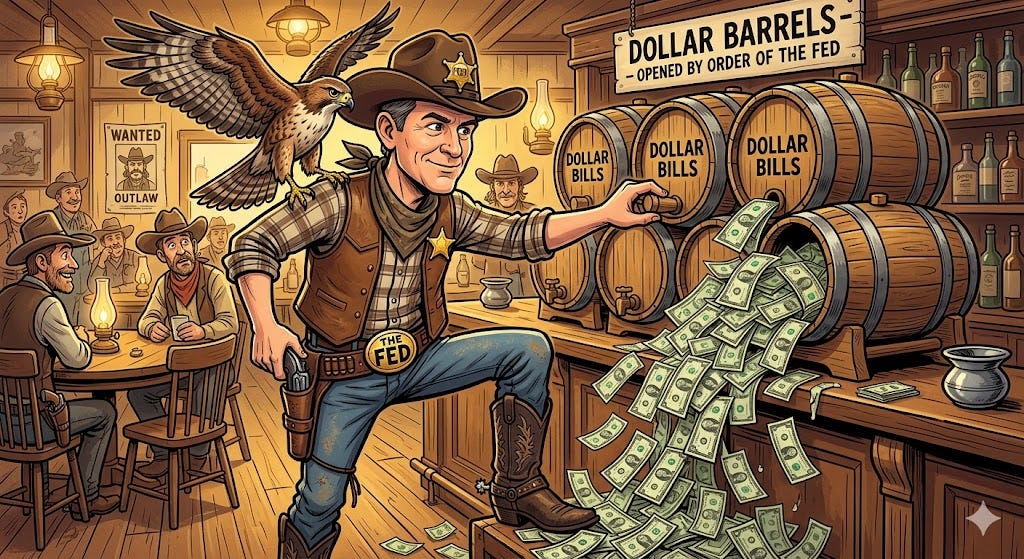
There has been no announcement, no press conference, and no carefully staged photo opportunity. He has simply started turning a very large dial in the opposite direction to the one the entire market had assumed it was about to turn, and the remarkable thing is how few people seem to have noticed him doing it.
I only noticed because I keep an eye on a handful of data series that most well-adjusted people don’t take the time to, which tells you roughly everything you need to know about the state of my social life. My wife has long since accepted this is how I like to spend my time, in the same way one accepts a partner who collects stamps or talks to the cat. My cat, for what it’s worth, finds my antics tedious.
The number in question is the size of the Fed’s balance sheet, which is simply the grand total of everything the central bank happens to be holding at any given moment, and for the past couple of weeks it has been quietly misbehaving. It has started to shrink. Not dramatically and not in any way that has troubled a single headline, but steadily and persistently enough that I’ve stopped filing it under noise and started filing it under intent.
This is roughly the financial equivalent of noticing that your famously frugal uncle has sneakily stopped topping up the punch bowl at his own party. Nobody else has clocked it yet, everyone is still having a grand old time. But the man with his hand on the ladle has plans, and they aren’t generous ones.
Here is why that ought to make you sit up a little straighter in your chair. Firstly, it’s good for your posture and preventing a future of looking like the hunchback of Notre Dame, but more importantly, the entire market is currently transfixed by the wrong hand – the one without the ladle.
The market is watching the interest rate and holding its breath for the first cut, reading each syllable the new Chair utters with the strained devotion of a medieval priest inspecting a goat’s liver for favorable omens.
That is the loud and theatrical half of monetary policy, the half that moves mortgages and leads the evening news, and it’s where the crowd always gathers to gawp.
Meanwhile the quieter half, which is simply how much money the Fed is pumping into or pulling out of the system, tends to tell you considerably more about what’s actually coming, and at the moment it is telling a story that flatly contradicts the one the rate-cut crowd has so cheerfully talked itself into.
What made me really take notice was the timing of the thing. The balance sheet carried on growing quite merrily right up until the week the Fed changed hands, and it has been shrinking ever since, which is either a coincidence of heroic proportions or the first faint sign that the new man intends to run the place rather differently to the last one.
I’ve spent enough time in and around this business, and if there’s one thing it has beaten into me, it’s a deep suspicion of coincidences that arrive this neatly gift-wrapped.
A market tends to be at its most interesting in precisely these moments, when it is busy contradicting itself and hasn’t yet thought to check its own arithmetic, and there is a contradiction exactly like that sitting in plain sight today, tucked discreetly behind a number that almost nobody can be bothered to watch.
Given the choice, I would far rather be a fortnight too early to something like this than spend the back half of the year explaining to myself why I sat on my hands and watched it unfold in front of me.
So let me walk you through how I’m reading it, because the order in which all this has unfolded matters far more than any single piece of it in isolation.
Right, How Did We Get Into This Mess
For a couple of years the Fed had been letting its balance sheet run down, allowing bonds to mature without replacing them and steadily draining reserves out of the banking system. Which worked perfectly well until it didn’t.
By late last year reserves had grown scarce enough that the overnight funding markets started to show real strain, with repo rates spiking in a way that made the Fed a little shaky in their boots, because it’s the early warning that they’re losing their grip on the very rate they’re trying to set.
So they did the predictable thing and started buying short-dated paper again to put reserves back. They’ve gone to considerable lengths to insist this isn’t a return to easing, just a spot of routine technical housekeeping, and they’ve chosen their words with great care. I don’t much care what they call it.
Money going back into the system is money going back into the system, whatever’s written on the paperwork, and a system being topped back up behaves accordingly.
The labor market, for one, has held up rather better than the AI-layoff panic earlier in the year insisted it would, which is more or less what you’d expect when liquidity is quietly being added, and is part of why I’m fairly confident that’s what was going on. So the robots aren’t coming for all of our jobs just yet. Reports of our collective redundancy, it seems, were somewhat exaggerated.
What interests me more is why they felt they had to. The official story is that the strain was confined to the money markets, and I’m not convinced that’s the top and bottom of it. The thing that’s been quietly swelling for years now is private credit, the vast and largely unwatched world of lending that happens outside the banking system. Essentially the wild west of the financial world.
When a pool of risk that size starts to seize up it doesn’t stay politely in its own corner, because all of this is wired together, and liquidity that disappears somewhere you can’t see has a habit of resurfacing as stress somewhere you can. I suspect the repo trouble the Fed rushed to patch was the visible edge of a problem sitting a good deal further out of view.

That was roughly the picture heading into spring. The Fed quietly topping liquidity back up, the system straining in places that don’t make the evening news, and an inflation picture that simply refused to cooperate, with fuel prices pushing higher, producer prices running hot, and the case for cutting rates getting harder to make with every release rather than easier.
That was the world the new Chair walked into.
New Sheriff, Same Saloon
In the middle of May the Federal Reserve got a new Chair, Kevin Warsh, confirmed by one of the narrowest margins in the institution’s history. I’m going to leave the politics of how he got there well alone, partly because it isn’t what we’re here for and partly because it’s genuinely the least interesting thing about him.
What actually matters is what he’s been telling everyone and their grandma’s dog for the best part of post-Covid years is that the Fed’s balance sheet has grown into something monstrous and ought to be a great deal smaller.
Warsh has spent the years since the financial crisis as one of the more consistent skeptics of the Fed’s swollen balance sheet you could hope to find. He sat on the Board during the crisis and backed the first round of emergency bond-buying in 2008, but he broke with the program when the Fed went back for seconds in 2010, and he’s been uneasy about the sheer size of the balance sheet ever since. That discomfort has only sharpened in the years since the pandemic ballooned it to a scale nobody could have imagined back then.
He resigned from the Board in 2011, walking away from one of the most powerful economic seats in the world, his unease with the direction of policy no secret at the time.
He has also spent years in the orbit of his mentor and business partner, the one and only Stanley Druckenmiller. Now if you’re reading this, Mr. Druckenmiller likely needs no introduction, but on the off chance you need a refresher, this is a man who isn’t exactly shy about expressing his views, and who has spent a good few years now calling the Fed’s money-printing roughly what he thinks it is, free money, growing rather louder about it since 2020.
Whatever else you make of Warsh, this is not someone who inherits a few trillion dollars of accumulated easing and decides to leave it all precisely where he found it.
There are two things going on here that the market seems to be having real trouble holding in its head at the same time, an increasingly common problem might I add. Jerome Powell, the predecessor, was cautious by temperament and ran the Fed accordingly. He ran what he openly called an ample-reserves regime, keeping plenty of liquidity in the system and perfectly willing to tolerate a bit more inflation if it meant nothing broke along the way.
Powell would rather run things slightly too loose than risk a seizure. Warsh’s instincts run in exactly the opposite direction. He wants the balance sheet smaller, and he’s likely to let it shrink faster and further than Powell would ever have allowed.
The market understood this the moment he was nominated, and you could read it most clearly in gold and silver, the assets that care most about whether the dollar holds its value and that tend to rally the instant people start worrying about debasement.
They sold off sharply on the news, as you can see in the chart above. And I know some of you will look at the chart and say the run up was caused by retail FOMO mania, but retail having money is just a side effect of the Fed’s expanding balance sheet (remember GameStop?). That’s the market handing you its own conclusion, and the conclusion it reached was that Warsh is far more likely to defend the currency than to quietly let inflation do the awkward work on his behalf.
Which brings me back to that shrinking number. A balance sheet that had been growing suddenly going into reverse, in the exact window a years-long balance-sheet hawk takes charge, against an inflation backdrop that hands him every excuse to keep draining.
I don’t believe that’s an accident, and if I’m right about it, then the trade that’s made me good money all year is now sitting on the wrong side of what comes next. There’s one particular corner of the market where this shift pays off twice over, and I started moving into it this week.
So I’ll stop boring you and get into the nitty gritty of where my mind, and money, is.
A brief and shameless interruption before we continue.
Pieces like this take an unreasonable amount of time to put together. There is the data gathering, the chart-making, the cross-checking, the reading of documents written by people who appear to have been paid by the sentence, and the eventual attempt to turn the whole thing into something a normal human being might willingly read over coffee.
The rest of this issue goes into the mechanics of the trade, the instruments I am using, the risks I am watching, and the specific thing that would make me abandon the thesis entirely.
A paid subscription is not required to keep the horses fed. They have made their financial expectations abundantly clear and, regrettably, remain well looked after. What it does tell me is that the hours spent staring at obscure data series, building charts, and writing pieces of questionable length are actually useful to someone other than me, which is usually enough encouragement to keep sharing what I know.
And whether or not you subscribe, feel free to share this article. You are also welcome to use any of the charts in your own posts, newsletters, or discussions, provided you share them as they appear here with the attribution left intact. The charts already carry the relevant credit, so there is no need to draft a ceremonial citation scroll in my honor.
